
A website redesign is one of the most exciting moments for any brand. New visuals, cleaner layouts, better UX, and faster performance all feel like a fresh start. But here’s the uncomfortable truth: a redesign can quietly destroy years of SEO progress if it’s not handled correctly.
Organic rankings don’t disappear overnight because Google “doesn’t like” your new design. They vanish because critical SEO elements get lost during the transition. That’s why redesign website SEO should never be an afterthought—it must be the backbone of the entire project.
The good news? When handled strategically, redesign website SEO doesn’t just protect rankings—it can dramatically improve them.
Why Website Redesigns Commonly Damage SEO
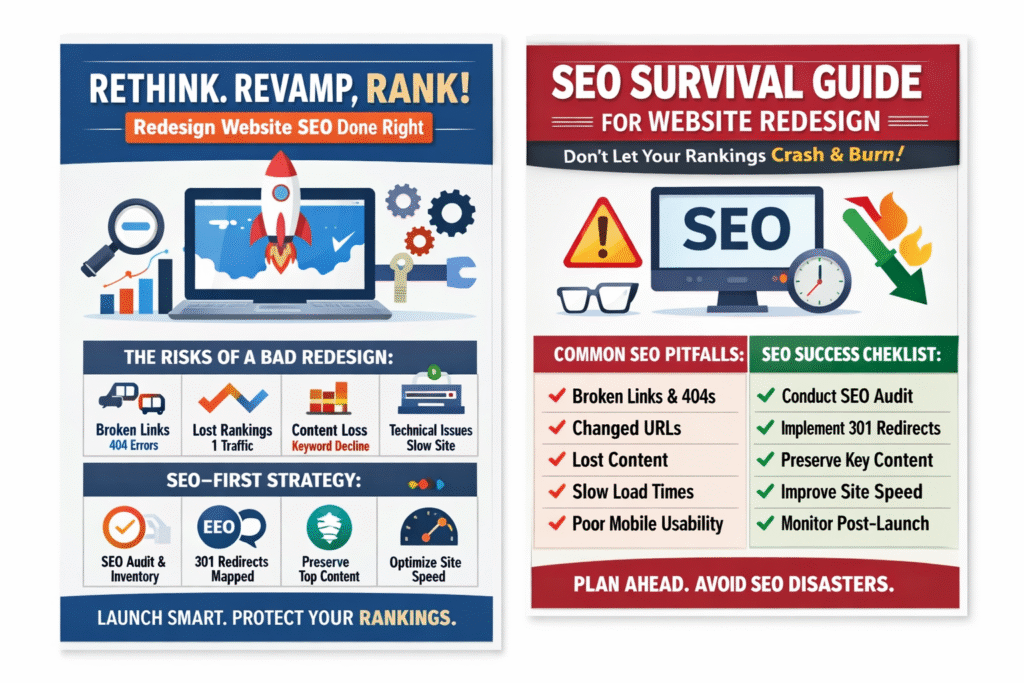
Search engines don’t see your website the way humans do. They rely on structure, signals, and consistency. When those signals suddenly change during a redesign, rankings wobble—or collapse entirely. Understanding these risks is essential to effective redesign website SEO.
Here are the most common SEO landmines during a redesign.
Broken URLs and Missing Pages
Changing URLs without proper redirects is the fastest way to lose rankings. Every indexed URL carries history, authority, and backlinks. If Google encounters a 404 instead of a redirect, that equity disappears.
Without a redirect strategy, you’re essentially telling search engines:
“Forget everything you knew about this page.”
This is one of the most common failures in poorly planned redesign website SEO projects.
Disrupted Site Architecture
Navigation changes may look cleaner to users, but drastic structural shifts can confuse search engines. If important pages are buried deeper or become orphaned, their visibility drops.
An SEO-friendly structure ensures:
- Clear hierarchy
- Logical internal linking
- Important pages remain easily crawlable
Strong site architecture is a foundational element of successful redesign website SEO.
Content Removal or Over-Editing
One of the biggest redesign mistakes is deleting “old” content that is actually ranking well. Even minor copy changes can strip pages of keyword relevance if done blindly.
If a page drives traffic, leads, or backlinks, it should be preserved—or improved strategically. Content protection is a critical pillar of redesign website SEO.
Technical SEO Regressions
New themes, page builders, or CMS platforms often introduce technical issues such as:
- Slower load times
- Mobile responsiveness problems
- Noindex or nofollow tag errors
- Broken schema markup
- JavaScript rendering issues
A visually stunning site that loads slowly will struggle to rank, regardless of design quality. Technical validation is non-negotiable in redesign website SEO.
The SEO-First Redesign Playbook
A successful redesign website SEO strategy starts before design mockups and continues long after launch.
1. Integrate SEO From Day One
SEO must be involved at the planning stage—not after the site goes live. This includes:
- URL structure decisions
- Content migration planning
- Platform and CMS selection
- Navigation and taxonomy
Treat SEO like infrastructure, not decoration. This mindset defines effective redesign website SEO.
2. Run a Pre-Redesign SEO Audit
Before touching anything, document your current performance. This becomes your safety net and benchmark.
Your audit should include:
- Keyword rankings and priority terms
- Top-performing pages by traffic and conversions
- Backlink profile and authority pages
- Technical health (crawlability, Core Web Vitals, mobile usability)
- Content inventory of every indexable URL
This data tells you exactly what must not be broken during your redesign website SEO process.
3. Create a Bulletproof 301 Redirect Map
Redirects are non-negotiable in redesign website SEO.
For every old URL:
- Map it to the most relevant new URL
- Use 301 (permanent) redirects only
- Avoid redirect chains
Tools like Screaming Frog or Ahrefs help crawl your existing site and export URLs for mapping. If a page no longer exists, redirect it to the closest topical match—not the homepage.
4. Preserve and Enhance High-Value Content
Instead of deleting content:
- Refresh it
- Improve structure and clarity
- Add updated data
- Strengthen keyword targeting
A redesign is the perfect opportunity to turn “good” pages into top performers using a smart redesign website SEO approach.
5. Optimize Technical SEO Before Launch
Before going live, validate:
- Page speed and Core Web Vitals
- Mobile-first responsiveness
- Clean, crawlable HTML
- Proper canonical tags
- XML sitemap accuracy
- Robots.txt settings
Never assume a new theme is SEO-ready. Technical testing is essential to redesign website SEO success.
6. Rebuild Internal Linking Strategically
Internal links distribute authority and signal importance. During a redesign:
- Ensure priority pages receive strong internal links
- Eliminate orphan pages
- Use descriptive, keyword-relevant anchor text
This reinforces topical relevance across the site and strengthens redesign website SEO performance.
7. Monitor Aggressively After Launch
Post-launch monitoring is where many teams fail. Track closely:
- Google Search Console coverage reports
- Organic traffic by page
- Keyword ranking changes
- Crawl and indexing errors
Minor fluctuations are normal—but major drops mean something is broken and must be fixed immediately.
A Redesign Should Be an SEO Upgrade, Not a Reset
A website redesign isn’t just a design project—it’s a major SEO event.
Handled poorly, it wipes out visibility.
Handled strategically through redesign website SEO, it:
- Improves rankings
- Increases crawl efficiency
- Boosts engagement
- Strengthens conversions
The difference lies in whether redesign website SEO is treated as a core pillar—or an afterthought.
Additional Frequently Asked Questions (FAQ)
What is redesign website SEO?
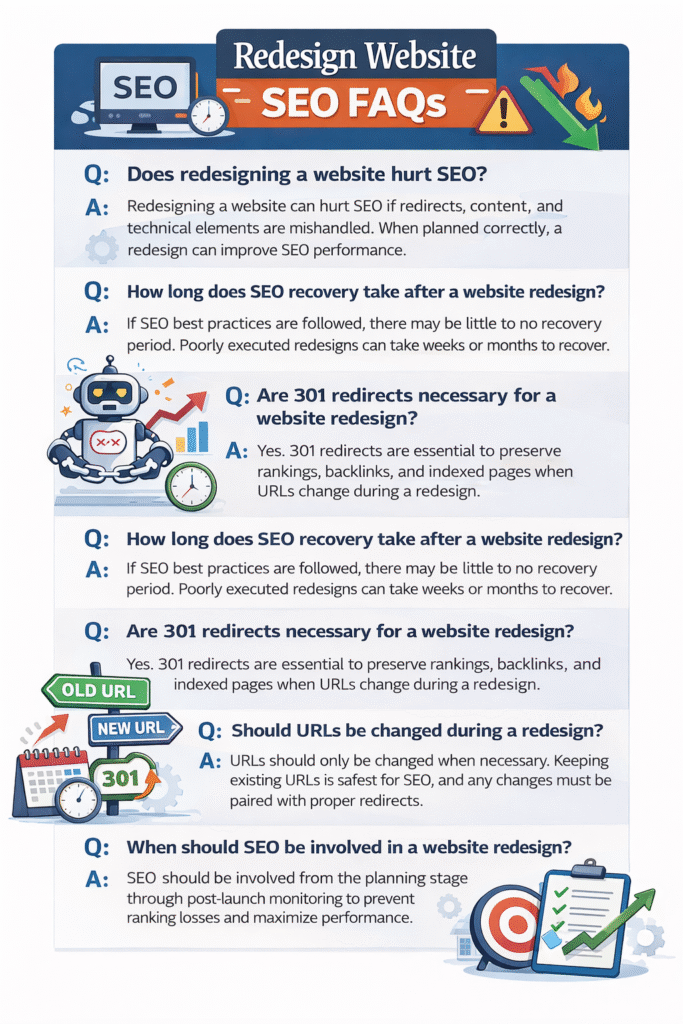
Redesign website SEO is the process of protecting and improving search engine rankings during a website redesign. It focuses on preserving URLs, content, internal links, and technical SEO signals while upgrading design and user experience.
Can redesign website SEO improve rankings instead of hurting them?
Yes. When handled correctly, redesign website SEO can improve rankings by fixing technical issues, improving site speed, strengthening content, and optimizing internal linking during the redesign process.
What should be checked first in redesign website SEO?
The first step in redesign website SEO is a full SEO audit. This includes reviewing keyword rankings, top-performing pages, backlinks, site structure, and technical health before any design changes begin.
Should SEO content be rewritten during a website redesign?
SEO content should not be rewritten blindly. High-performing pages should be preserved and enhanced, not removed. Strategic updates aligned with redesign website SEO best practices can improve relevance without losing rankings.
How do redirects impact redesign website SEO?
Redirects are critical to redesign website SEO. Proper 301 redirects ensure that link equity, rankings, and indexed URLs transfer correctly when pages move or URLs change.
Is redesign website SEO different for large websites?
Yes. Large websites require more detailed redirect mapping, crawl budget optimization, and internal linking audits. The larger the site, the more important a structured redesign website SEO strategy becomes.
When should Google Search Console be monitored during a redesign?
Google Search Console should be monitored before launch, immediately after launch, and continuously during the weeks following deployment to catch indexing, coverage, and ranking issues early.
Ready to Redesign Without Losing Your Rankings?
A website redesign doesn’t have to cost you traffic, leads, or visibility. With a strategic redesign website SEO approach, you can launch with confidence—knowing your rankings are protected and positioned to grow.
👉 Planning a redesign?
Get expert guidance to audit your current site, map critical redirects, preserve high-value content, and optimize SEO before launch.
Contact us today to make your website redesign an SEO upgrade—not a setback.